future dates for real
[ + link to: Fictional Dates ]
Some future events and situations are certain, and datable to a greater or lesser degree of accuracy...
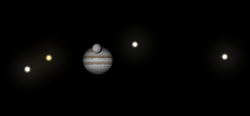 this one happened 3rd January 1818
2029
Friday 13th April: Asteroid 99942 Apophis will pass as close as 19,600 miles to the Earth's surface.
2035
Periastron of Alpha Centauri A and B.
2040
8th September: a rare alignment of the 5 naked-eye planets within a ten-degree patch of sky.
2044
1st October: Venus will occult Regulus. This last happened on 7 July 1959. [Astronomy Now, November 2018, p104]
Halley's Comet returns.
22nd November: transit of Jupiter by Venus - the first for 247 years.
2076
Dwarf planet Sedna will reach perihelion, at 76 AU. (Then after another 11,400 years or so it will reach aphelion at 937 AU.)
2078
3rd October: Mars will occult Theta Ophiuchi. The previous occasion on which Mars occulted a bright star was 8th April 1976, the star then being Epsilon Geminorum. [Astronomy Now, November 2018, p104.]
11th August: occultation of Mars by Mercury.
The next total solar eclipse visible from England; it will be visible (weather permitting) over the West Country. (See Eighty Not Out by Patrick Moore, page 150.)
2114
February: Pluto will be at aphelion.
2117
December: the next Transit of Venus.
2186
16th July: total solar eclipse, the longest in a span of 12,000 years; totality will last 7 minutes and 29 seconds at maximum - close to the theoretical maximum of 7 minutes and 31 seconds.
2nd December: Mars will occult Jupiter (for the first time since 9th May 2948 B.C.).
2227
Neptune will again be further from the Sun than Pluto is in September 2227.
2287
On 28th August, Mars will be even closer than at the opposition of 2003 when it approached to within 34,646,418 miles. If there are still amateur telescope-users on Earth in 2287, they should be looking forward to the day...
2439
The autumnal equinox will enter Leo.
2576
August 7, 2576: The final limit of the original Smithsonian Astrophysical Observatory's Modified Julian Date (MJD) system before a system epoch reset.
2597
The vernal equinox leaves Pisces and enters Aquarius.
2600
5th May: a total solar eclipse visible at London.
2656
Triple conjunction of Mars, Jupiter and Mercury.
2880
16th March: A small probability exists that Asteroid 1950DA (about 0.7 miles across) will hit Earth.
3886
Alignment of the Sun, Earth, Jupiter and Pluto.
4385
Return of Comet Hale-Bopp (the bright comet of 1997). [Sky at Night Magazine, July 2025, p41]
5800
By this time, Omega Carinae (magnitude 3.29) will have approached closer than 1° to the south celestial pole.
6757
An ultra-rare simultaneous occurrence of a total solar eclipse and a transit of Mercury across the Sun.
7541
16th February: occultation of Saturn by Jupiter.
8569
Voyager 2 will be 4.026 light-years from Barnard's Star. [Astronomy Now, March 1990, p28]
(See 11,800.)
9800
Around this year Deneb will be an approximate Pole Star (about 7° from the north celestial pole).
11,800
The Solar System and Barnard's Star will have approached to about 3.8 light-years from each other (the closest they'll get).
15,232
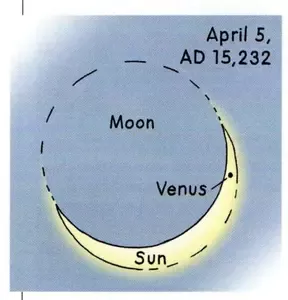
5th April: A rare combination of events: a Venus transit during a solar eclipse.
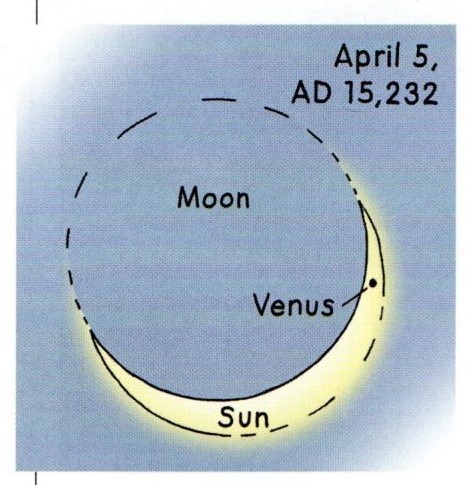 from Sky & Telescope August 2004, p138
15,300
Beta Pictoris will be within 6° of the South Celestial Pole. [POTF]
20,279
Voyager 2 will be 3.211 light-years from Proxima Centauri. [Astronomy Now, March 1990, p.28]
20,584
Voyager 2 will be 3.47 light-years from Alpha Centauri. [Astronomy Now, March 1990, p.28]
22,000
Around this time Lalande 21185 will be at its closest to Earth: 4.6 light-years.
22,400
Thuban will have returned to within 2° of the North Celestial Pole, and will therefore be as much of a Pole Star as it was for the ancient Egyptians in 2800 B.C. [POTF]
35,000
By this time Ross 248 has approached to just over 3 light-years' distance, and is the closest star to the Sun, having displaced Alpha Centauri from that role.
40,170
Voyager 2 will be 1.648 light-years from Ross 248.
69,163
26 July: Mercury and Venus will transit the Sun simultaneously for the first time since 22 September 373,173 B.C.
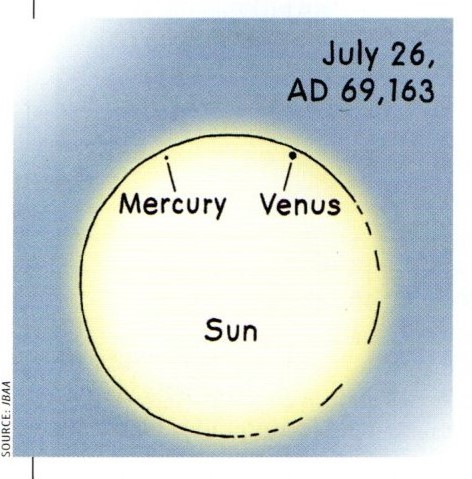 from Sky & Telescope August 2004, p138
70,000
Sirius will be within a few degrees of the South Celestial Pole. [POTF]
224,508
27-8 March: Mercury and Venus will transit the Sun simultaneously for the first time since 69,163.
290,000
For a few millennia either side of this date, Vega will shine at magnitude -0.8, compared with its current 0.03, and will be the brightest star in our night sky. Its distance will have decreased from 25 to 17 light-years.
[Fred Schaaf, "Vega on High", Sky & Telescope, July 2004, p.58]
298,477
Voyager 2 will have approached to 4.295 light-years from Sirius. [Astronomy Now, March 1990, p.28]
14,000,000
The Sun, as it bobs up and down along its orbit of the Galaxy, will be around its maximum height (about 250 light-years) above the galactic plane.
600,000,000
Around this time, total solar eclipses will cease, because the apparent diameter of the receding Moon will have become too small to cover the Sun's disk.
André G Borledeau, "A Journey in a Celestial Time Machine: Polestars of the Future" (Sky & Telescope, March 2008, p66-9) [=POTF]
Zendexor greatly appreciates your donation of £2! Thank you.
Recent Articles and Updates


-
Uranian Throne episode 24 Underway
Sep 15, 26 01:39 PM
 The skyfleet sails into Fyaym
 -
Guess The World - how many scenes on each world
Sep 15, 26 11:11 AM
 how each world is doing on the scenic front
 -
What to see on Jupiter
Sep 15, 26 11:06 AM
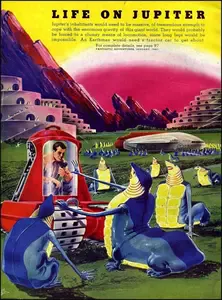 The Jovian scene
 -
Guess The World - Seventh Series
Sep 14, 26 09:08 AM
 Yet more scenes from Solar System worlds
 -
Deeds of the Creators
Sep 14, 26 07:35 AM
 in addition to expanding our consciousness
 -
Countries
Sep 14, 26 07:05 AM
 Supplementary Gazetteer for countries in sf scenes
 -
What to see on Venus
Sep 14, 26 02:01 AM
 The Venusian scene
 -
Fictional Dates of the Old Solar System
Sep 13, 26 07:17 AM
 our timeline extended into imagined pasts and futures
 -
Artists who have illustrated the Old Solar System
Sep 12, 26 08:00 AM
 visual depictions of the OSS
 -
What to see on Mars
Sep 12, 26 07:33 AM
 The Martian Scene
 -
Haunted Worlds - Fictional auras of places on Earth, the Moon and Mars
Sep 11, 26 11:22 AM
 The double life of our place-names
 -
What to see on Phobos
Sep 07, 26 05:36 AM
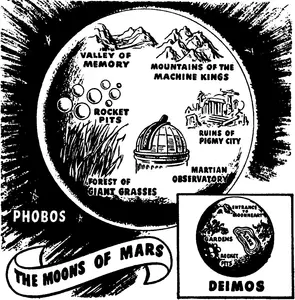 the scene on the inner moon of Mars
 -
CLUFFS
Sep 06, 26 11:33 AM
 CLUFFS - Cute Little Unfulfilled Fragments of Fascination
 -
Idea for another site - The Stellar Neighbourhood
Sep 06, 26 11:10 AM
 the named or designated stars that appear in literature
 -
What to see on the Moon
Sep 04, 26 03:38 AM
 The lunar scene
 -
What to see on the Asteroid Progenitor Planet
Sep 03, 26 09:18 AM
 The Lost Planet scene
 -
Zendexor's OSS Diary 2026
Sep 01, 26 03:26 PM
 reflections on life, the oss and everything
 -
the hits race
Sep 01, 26 11:44 AM
 the monthly popularity-contest for worlds
 -
What to see on Callisto
Aug 24, 26 04:09 AM
 The Callistan scene
 -
Jasoomian Gathol
Aug 22, 26 08:40 AM
 dreams and themes from an island
 -
History of Hopes
Aug 18, 26 03:27 AM
 Optimistic science and speculation
 -
What to see on Uranus
Aug 17, 26 03:12 AM
 The Uranian scene
 -
Future Dates for Real
Aug 12, 26 02:39 PM
 prophecies which are quite certain
 -
What to see on Mercury
Aug 11, 26 07:51 AM
 The Mercurian scene
 -
Authors of the Old Solar System
Aug 11, 26 07:49 AM
authors who have contributed to the old solar system -
Uranian Throne dates
Aug 02, 26 12:08 PM
exact dates referred to in Uranian Throne -
What to see on Neptune
Aug 02, 26 06:48 AM
 The Neptunian scene
 -
Religion in the Old Solar System
Jul 29, 26 08:41 AM
 Creeds and transcendence in the Old Solar System
 -
Invasions of Earth
Jul 27, 26 12:53 PM
 Terra targeted by other Solar System worlds