what to see on
triton
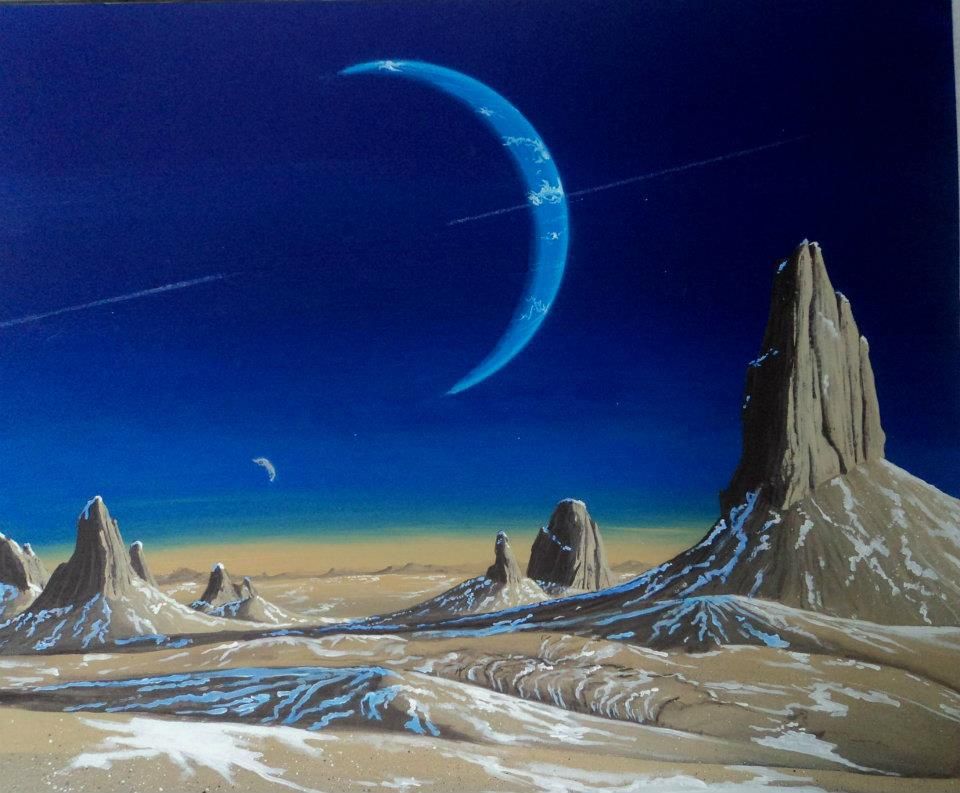
For a scenic browse, and an answer-page for Guess The World...
deadly tritonian crawlers
"...The children grow weak, from hunger. There us but one recourse left us. That is to hunt Crawlers."
Carter was dismayed and stared at Kur-saa in horror.
"Hunt Crawlers? Kur-saa, you know that's suicide. If you go into those marshes and try that - "
"There is no other way." The old man shrugged hopelessly. "Some of our young men are scouting the marshes now. If they find - "
A shrill, agonized cry interrupted the old man's words...
Carter's heart sank at what he saw... from the direction of the great reed-marsh eastward, came a small group of young tribesmen carrying two limp burdens.
They put them down. A chorus of heart-broken wails came from the women. Carter stepped forward and took a look and then turned away, a little sick.
He'd seen men before who had been caught by the Crawlers and pulped. But it was still a stomach-churning sight. The two corpses were just skeletons with skin round them. When a Crawler caught a man and pulped him, every bit of blood and tissue was sucked out of him...
Edmond Hamilton, Trouble on Triton (Startling Stories, Fall 1945)
robbing a temple on triton
…Cautiously, he
wiped the snow off the single enormous eye that occupied the centre of the
idol’s forehead. The eye flashed fire at
him; blue-white, transparent, lustrous as a diamond. It had been cut, diamond fashion, in many
facets, to resemble the many-lensed, insect-like eyes of the Tritonians
themselves. The eye was set in a band of
cement. Larsen tested that cement with a
chisel. He cursed. It was almost as hard as the bort from which
the idol had been hewn. He dared take no
chances on scratching the Eye. He turned
on his torch full blast, and began to cut into the bort around the cement,
careful to keep the flame away from the Eye.
Sudden heating might crack that mysterious stone.
Larsen worked
feverishly, forgetful of time, sweating despite the chill, until he felt a
draught on his back; a cold that bit through his space-suit to his very
marrow. Snowflakes were swirling around
him. The dawn-wind, blowing through the
hole in the door! On Triton, the
hydrogen atmosphere froze every night.
From either side,
winds rushed in to fill the vacuum, but themselves froze before they had gone
far.
The Eye seemed
loose in its socket. Larsen turned down
the torch. Cautiously, he grasped the
cement. The Eye came away in his hand. He was used, by now, to the low gravity of
Triton, but the lightness of the stone surprised him. It seemed as light as pumice.
Larsen looked up
just in time. The Tritonians were
stirring! The wind, so cold to him, was
warm to them; it meant air to them.
Those great pale eyes – one to each Tritonian – were fixed on him,
glaring with a phosphorescent luster.
There was no expression on their gargoyle faces. Their cavernous mouths gaped open; toothless,
but rimmed with razor-sharp horn, like the jaws of a snapping turtlel. The snow
dropped from them; their lobster-segmented shells were dull black, like the
bort of the statue. They were closing in
on him. He could not tell their numbers;
behind those visible, more kept crowding out of the shadows…
Charles A Baker, Treasure of Triton (Planet Stories, Spring 1941)
>> Guess The World - Third Series
captives on triton
An hour later they were there, slanting down over a terrain of desert
and serrated cliffs. The great ball of Neptune hung behind, filling
half the sky, its glow casting just enough light over the satellite to
tinge everything with a greenish grotesquerie.
"Lord, that gives me the creeps!" Blake muttered, peering out.
"This little planet must be pretty heavy, though," Janus estimated.
"Gravity seems about right."
They passed beyond the cliffs and over a large desert. Then, far ahead,
they saw the towering stone edifices of a city, gleaming a ghastly
skull-white in the green tinged atmosphere. Devries turned his face
away. He recognized the city from the Martian's description.
Before they quite, reached there, however, Blake cried: "Look! Down
there!"
Far below them, covering a large section of desert, were row after
row of blunt-nosed objects, looking like tiny silvery bugs, except
they were motionless. But they weren't bugs. They were space-ships.
Hundreds, perhaps thousands of them in formidable array.
Ketrik stared, then turned to Devries and exclaimed: "Hah! Thought you
said these Proktols stuck close to home! Off-hand I'd say they've got
other ideas now. I wonder what? I don't like the look of that fleet
down there!"
But now their spacer was gliding in low over the city, settling down
into landing cradles.
Janus turned to his men. "If we see a chance, we'd better make a break
for it! I'd like to get at the Controls of this ship just once!"
"I'd rather get at our atom-blasts!" Ketrik snapped.
But they had no chance to do either. A score of the Proktols, with
flame-pistols alert, came to escort them out. As they marched down a
wide avenue thousands of the gathered populace gave vent to prolonged
shouting, or rather shrilling. It was definitely unfriendly, and
somehow fanatical, anticipatory.
The Earthmen looked at these inhabitants with interest. They seemed to
be Proktols too, but in several ways were different from V'Naric and
the others. They were smaller, hardly four feet tall, and frailer if
that were possible. And they had no antennae. Neither did they wear any
raiment that the Earthmen could see—evidence of their semi-savagery.
But they seemed to respect the larger Proktols, for although their
shrilling continued, they kept their distance and didn't touch the
Earthmen.
"Just listen to those devils!" Blake said. "They're waiting, expecting
something!"
They reached a vast plaza in the center of the city. Their captors
marched them through the mass of shrilling little coppery devils, and
into a building; then up a flight of stairs and into a bare stone room
with a single tiny window looking out upon the square below...
Henry Hasse, Proktols of Neptune (Planet Stories, Summer 1941)
>> Guess The World - Third Series
exotic illusions on triton
Planet
X—or Neptune's moon, Triton—was a vast mirage with
many facets. Atmosphere was as dense and still as water in ocean deeps. Sky was
cloudless, but not clear, apparently built up of different layers of gases, and
the light was both glaring and erratic. At a distance of over three and a half
billion miles from the Sun, most of the light was not sunlight, and the little
that came through the air ocean was filtered and absorbed into curious colors
and intensities. Other illumination sources were auroral displays, radioactive
hotspots that glowed like eery ghosts, and volcanic outbursts of crimson or
gold.
Surface pressure of the atmospheric ocean was extreme, and
the gas densities and weird light gave an uncanny submarine illusion. Venturing
onto the surface of Triton, Torry felt like a diver in that long-past period
when man's last frontier on Earth had seemed the ocean deeps. Gravity, greater
than on Mars, but less than Earth's, gave a sense of buoyancy; the spacesuiting
was not unlike ancient diving costume; and the thickness of the atmosphere
itself suggested deep, still water.
Most disturbing of all were the mirages. All the familiar
effects of Earth mirages were present but magnified and even multiplied into
infinite complexities. To a scientist of optics or meteorology, Triton would
be a superb laboratory. To Torry, it was—
Near madness...!
Mirages by hundreds and thousands floated between surface
and zenith, or hugged the ground like captive nightmares. Pinnacled dream
mountains rose from bases of empty air. Phantom battlements and mock castles
stormed upward from nothing. Magnified rockeries became goblin cities, looming
near or far in equal scale. Water glittered in the sky and on the ground, and
floating debris became fleets of fairy argosies. Lateral mirages played eery
jokes with distance. All images seemed unreal, and diffraction haloed them with
misty, rainbow coloring.
Triton itself was bleak, savage, merciless, nearly
windless but for vagrant currents of slow-moving dense air, like currents in an
ocean.
By levels, temperatures were absurdly high or low, depending
upon location or freak circumstances. It was a lifeless world, inhospitable to
man. But it wore a mask and costume of exotic, lying beauty, and masquerade was
hard to distinguish from the harsh reality. Anything definite was hard to
distinguish...
Stanley Mullen, Mirage for Planet X (Planet Stories, Spring 1955)
>> Guess The World - Seventh Series
Comment from contributor Lone Wolf:
Another forgotten author I found recently. His stories are quite good, mostly consisting of intrigues and adventures set in the same universe of vividly imagined planets of the Solar system. Here the description of Triton (mentioned in the title and the text also as “Planet X” for a reason that doesn't become completely clear), although uninhabited, is interesting also with the notion of it being a dense, high-gravity world (which I haven't met elsewhere, save for the story Siren Satellite by Arthur K. Barnes). As one of the characters explains it:
"So Planet X is not even a planet, just one of
Neptune's moons?"
"Perhaps it was a planet once. Both Pluto and Triton
are not like the rest of the solar system planets. They may have been two stray
worlds from outer space, captured long ago by our sun. For their size they have
mass out of all proportion. The quantities of heavy metals beyond uranium give
them extreme weight and density. Pluto has a density of over fifty times that
of water. Triton not so much, but still greater by far than Earth's density,
which is roughly five or six times that of water. Though smaller than Mercury
or Ganymede, Triton has a gravity only slightly less than Earth's and a far
denser atmosphere blanket."
beware of what you think on triton
Triton
was not an ocean-world like its parent planet.
The moon was covered with rolling green plains, and seemed a peaceful,
inviting place. Yet Captain Future was
the only person in the whole system who ever dared to land on that
innocent-seeming world!
“There’s the Tritonians' city,” Curt
said soon, pointing. “Land just outside
it, Otho.”
“The queerest city in the System,”
growled Otho. “A city without buildings.”
“The Tritonians are too far
advanced mentally to have need of material buildings,” commented the Brain in
his rasping voice, his lens-eyes peering keenly.
The Tritonian “city” was nothing
but a great smooth metal platform of circular shape, several miles across. The Comet landed nearby. Curt and the Futuremen emerged, Grag carrying
the Brain. As they stood in the thin
sunlight, they became conscious of a tingling force pervading them.
“We’re inside the Tritonians' zone
of ‘creation force’!” warned Captain Future.
“Watch your thoughts!”
“That’s the devil of this place!”
complained Otho. “You think of something
like a Plutonian ice-tiger, and right away – ”
“Look out – you’ve done it now!” Curt
shouted.
For as Otho spoke the words, the very
beast he had mentioned appeared suddenly out of thin air beside him, miraculously
solid and real.
A Plutonian ice-tiger, a great,
hairy, snarling beast that reared up furiously to attack the android!
“Think him away, quick, Otho!” yelled Captain
Future. “Think him into something else!”
Desperately, Otho thought of the
snarling monster changing into a harmless rodent. And, immediately, the ice-tiger changed
miraculously into just such a scared little rodent...
Edmond Hamilton, Captain Future's Challenge (1940, 1967)
>> Guess The World - Seventh Series
Zendexor greatly appreciates your donation of £2! Thank you.
Recent Articles and Updates


-
Uranian Throne episode 24 Underway
Sep 15, 26 01:39 PM
 The skyfleet sails into Fyaym
 -
Guess The World - how many scenes on each world
Sep 15, 26 11:11 AM
 how each world is doing on the scenic front
 -
What to see on Jupiter
Sep 15, 26 11:06 AM
 The Jovian scene
 -
Guess The World - Seventh Series
Sep 14, 26 09:08 AM
 Yet more scenes from Solar System worlds
 -
Deeds of the Creators
Sep 14, 26 07:35 AM
 in addition to expanding our consciousness
 -
Countries
Sep 14, 26 07:05 AM
 Supplementary Gazetteer for countries in sf scenes
 -
What to see on Venus
Sep 14, 26 02:01 AM
 The Venusian scene
 -
Fictional Dates of the Old Solar System
Sep 13, 26 07:17 AM
 our timeline extended into imagined pasts and futures
 -
Artists who have illustrated the Old Solar System
Sep 12, 26 08:00 AM
 visual depictions of the OSS
 -
What to see on Mars
Sep 12, 26 07:33 AM
 The Martian Scene
 -
Haunted Worlds - Fictional auras of places on Earth, the Moon and Mars
Sep 11, 26 11:22 AM
 The double life of our place-names
 -
What to see on Phobos
Sep 07, 26 05:36 AM
 the scene on the inner moon of Mars
 -
CLUFFS
Sep 06, 26 11:33 AM
 CLUFFS - Cute Little Unfulfilled Fragments of Fascination
 -
Idea for another site - The Stellar Neighbourhood
Sep 06, 26 11:10 AM
 the named or designated stars that appear in literature
 -
What to see on the Moon
Sep 04, 26 03:38 AM
 The lunar scene
 -
What to see on the Asteroid Progenitor Planet
Sep 03, 26 09:18 AM
 The Lost Planet scene
 -
Zendexor's OSS Diary 2026
Sep 01, 26 03:26 PM
 reflections on life, the oss and everything
 -
the hits race
Sep 01, 26 11:44 AM
 the monthly popularity-contest for worlds
 -
What to see on Callisto
Aug 24, 26 04:09 AM
 The Callistan scene
 -
Jasoomian Gathol
Aug 22, 26 08:40 AM
 dreams and themes from an island
 -
History of Hopes
Aug 18, 26 03:27 AM
 Optimistic science and speculation
 -
What to see on Uranus
Aug 17, 26 03:12 AM
 The Uranian scene
 -
Future Dates for Real
Aug 12, 26 02:39 PM
 prophecies which are quite certain
 -
What to see on Mercury
Aug 11, 26 07:51 AM
 The Mercurian scene
 -
Authors of the Old Solar System
Aug 11, 26 07:49 AM
authors who have contributed to the old solar system -
Uranian Throne dates
Aug 02, 26 12:08 PM
exact dates referred to in Uranian Throne -
What to see on Neptune
Aug 02, 26 06:48 AM
 The Neptunian scene
 -
Religion in the Old Solar System
Jul 29, 26 08:41 AM
 Creeds and transcendence in the Old Solar System
 -
Invasions of Earth
Jul 27, 26 12:53 PM
 Terra targeted by other Solar System worlds