what to see on
deimos
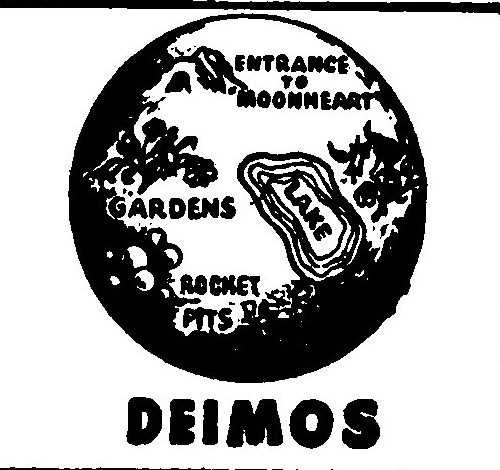 from the Captain Future saga
clever arachnida of deimos
Bruce was more or less familiar with the scanty vegetation and animal life among the rocks nearby. Years before, he had piloted an exploration party from Earth, consisting of four eminent men of science, which had spent some time in studying this tiny moon.
After several busy hours, Bruce stole a few minutes to search the pitted face of the cliff near which he was working. There was nothing to fear from these aboriginal dwellers of Deimos, as he was well aware, for he remembered them as inoffensive, sessile-eyed, snail-footed Arachnida, only a few inches tall. But he was wondering if this strange, unknown thing which Horker had hatched from his pebbles had affected them in any visible manner.
Although small, sluggish creatures, these Arachnida, he remembered, possessed an intelligence considerably higher than that of any animal of Earth – a quaint, semi-human intelligence, which enabled them to use certain primitive tools.
And now, here in the shallow niches of the cliff, he found their tiny, conical, adobe huts. His eyes traced the small terraces lying before the huts, filled with dark loam which the industrious Arachnida had carefully collected from the scanty supply available.
But these small gardens were neglected, the tiny huts abandoned…
D L James, Crystals of Madness (Thrilling Wonder Stories, October 1936)
>> Guess The World - Third Series
pouring beer on deimos
“I’m fed up with squirting my beer out of a bulb,” he explained. “I
want to pour it properly into a glass now we’ve got the chance again.
Let’s see how long it takes.”
“It’ll be flat before it gets there,” warned Mackay. “Let’s see – g’s about half a centimetre a second squared, you’re pouring from a height of…” He retired into a brown study.
But the experiment was already in progress. Scott was holding the
punctured beer-tin about a foot above his glass – and, for the first
time in three months, the word “above” had some meaning, even if very
little. For, with incredible slowness, the amber liquid oozed out of
the tin – so slowly that one might have taken it for syrup. A thin
column extended downwards, moving almost imperceptibly at first, but
then slowly accelerating. It seemed an age before the glass was
reached: then a great cheer went up as contact was made and the level of
the liquid began to creep upwards…
Arthur C Clarke, The Sands of Mars (1951)
>> Guess The World - Sixth Series
marginally habitable deimos
...All this while the ship and ourselves had been drifting
towards Deimos. The little world was as prominent as Mars in the sky now. The
ship was clearly still making for Deimos.
"Ancient Martian history tells of colonies on Deimos,
of cities, air-plants and supplies left intact when the place was
evacuated," Usulor told us. "Many thousands of years ago, of course.
But most of it is probably still usable."
"Why was the world evacuated?" I asked.
"Because of radiations, the old books say. That might
mean cosmic rays, or ultra-violet or radium emanations. It might mean almost
anything."
(...)
AS WE got nearer
to Deimos we saw that what looked like disks of
pale green glass were dotted about the surface of the tiny world, some of them miles in diameter.
"Air and temperature traps," Usulor
explained. "Former Martian
colonies. Radiant heat goes in through the glassite readily but seeps out only
very slowly."
I could easily
understand that. I have grown tomatoes in a hothouse or greenhouse. On Deimos men had tried to live in giant
greenhouses. Without much success, it appeared.
(…)
After a long, long journey we reached Deimos. A desert,
uninviting world, apart from the hothouse colonies. Jagged mountains, thin air,
polar ice-caps, no extensive seas, some stunted vegetation in the valleys. No
place for a honeymoon...
Festus Pragnell, Devil Birds of Deimos (Amazing Stories, April 1942)
>> Guess The World - Seventh Series
Comment from contributor Lone Wolf:
This is the fifth story from Festus Pragnell's Martian
series about the adventures of Don Hargreaves - not too bad a one, although
without many details. (This series starts with a rather serious story entitled
Ghost on Mars, where is introduced the idea of Martians living in great
underground caverns inside the planet after the atmosphere has dissipated ages
ago, which setting seems almost realistic, but then in the sequels, already
written in first person, the plot gradually deteriorates into a silly parody of
the planetary romance genre. The author even seems to forget or simply not to
care, that the events he describes were originally supposed to be in the future, and treats them as if they happen in real time). The notable thing here is that
in this excerpt Deimos is represented as a world in itself, even though a
miniature one: it is said that it has polar ice-caps (the author obviously
imagines it as spherical), vegetation and “no extensive seas” (does this mean
that there still are some kind of seas?). No more details are given in the
story itself, which happens mostly inside an artificial dome of an ancient Martian
colony, but we still receive the impression of a little planet and not just a
big rock orbiting around Mars.
Comment from Zendexor:
For me it's the
"stunted vegetation" which, in this excerpt, causes the scene to make the grade as a
world. And with regard to the idea of ancient Martian
colonies: this reminds me, there's a comparative lack of tales that feature
other-world colonists, as opposed to colonies sent out by Earth, except of
course for various invasions of Earth itself and the alien attempts to settle there. So, "alien neighbouring worlds planting colonies on each other" is something to add to the accumulating list of tales unwritten.
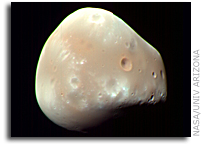 the real one
Zendexor greatly appreciates your donation of £2! Thank you.
Recent Articles and Updates


-
Deeds of the Creators
Sep 18, 26 02:00 PM
 in addition to expanding our consciousness
 -
Authors of the Old Solar System
Sep 18, 26 01:09 PM
authors who have contributed to the old solar system -
Guess The World - how many scenes on each world
Sep 18, 26 04:15 AM
 how each world is doing on the scenic front
 -
Guess The World - Seventh Series
Sep 18, 26 04:10 AM
 Yet more scenes from Solar System worlds
 -
What to see on the Moon
Sep 18, 26 04:05 AM
 The lunar scene
 -
Haunted Worlds - Fictional auras of places on Earth, the Moon and Mars
Sep 17, 26 12:30 PM
 The double life of our place-names
 -
Fictional Dates of the Old Solar System
Sep 16, 26 12:17 PM
 our timeline extended into imagined pasts and futures
 -
Zendexor's OSS Diary 2026
Sep 16, 26 11:10 AM
 reflections on life, the oss and everything
 -
Uranian Throne episode 24 Underway
Sep 15, 26 01:39 PM
 The skyfleet sails into Fyaym
 -
What to see on Jupiter
Sep 15, 26 11:06 AM
 The Jovian scene
 -
Countries
Sep 14, 26 07:05 AM
 Supplementary Gazetteer for countries in sf scenes
 -
What to see on Venus
Sep 14, 26 02:01 AM
 The Venusian scene
 -
Artists who have illustrated the Old Solar System
Sep 12, 26 08:00 AM
 visual depictions of the OSS
 -
What to see on Mars
Sep 12, 26 07:33 AM
 The Martian Scene
 -
What to see on Phobos
Sep 07, 26 05:36 AM
 the scene on the inner moon of Mars
 -
CLUFFS
Sep 06, 26 11:33 AM
 CLUFFS - Cute Little Unfulfilled Fragments of Fascination
 -
Idea for another site - The Stellar Neighbourhood
Sep 06, 26 11:10 AM
 the named or designated stars that appear in literature
 -
What to see on the Asteroid Progenitor Planet
Sep 03, 26 09:18 AM
 The Lost Planet scene
 -
the hits race
Sep 01, 26 11:44 AM
 the monthly popularity-contest for worlds
 -
What to see on Callisto
Aug 24, 26 04:09 AM
 The Callistan scene
 -
Jasoomian Gathol
Aug 22, 26 08:40 AM
 dreams and themes from an island
 -
History of Hopes
Aug 18, 26 03:27 AM
 Optimistic science and speculation
 -
What to see on Uranus
Aug 17, 26 03:12 AM
 The Uranian scene
 -
Future Dates for Real
Aug 12, 26 02:39 PM
 prophecies which are quite certain
 -
What to see on Mercury
Aug 11, 26 07:51 AM
 The Mercurian scene
 -
Uranian Throne dates
Aug 02, 26 12:08 PM
exact dates referred to in Uranian Throne -
What to see on Neptune
Aug 02, 26 06:48 AM
 The Neptunian scene
 -
Religion in the Old Solar System
Jul 29, 26 08:41 AM
 Creeds and transcendence in the Old Solar System
 -
Invasions of Earth
Jul 27, 26 12:53 PM
 Terra targeted by other Solar System worlds